On today’s “What Zoe Read,” I’m featuring three incidental books. Books I wandered into because I couldn’t quit the author yet or because a book looked really good on the library shelf.
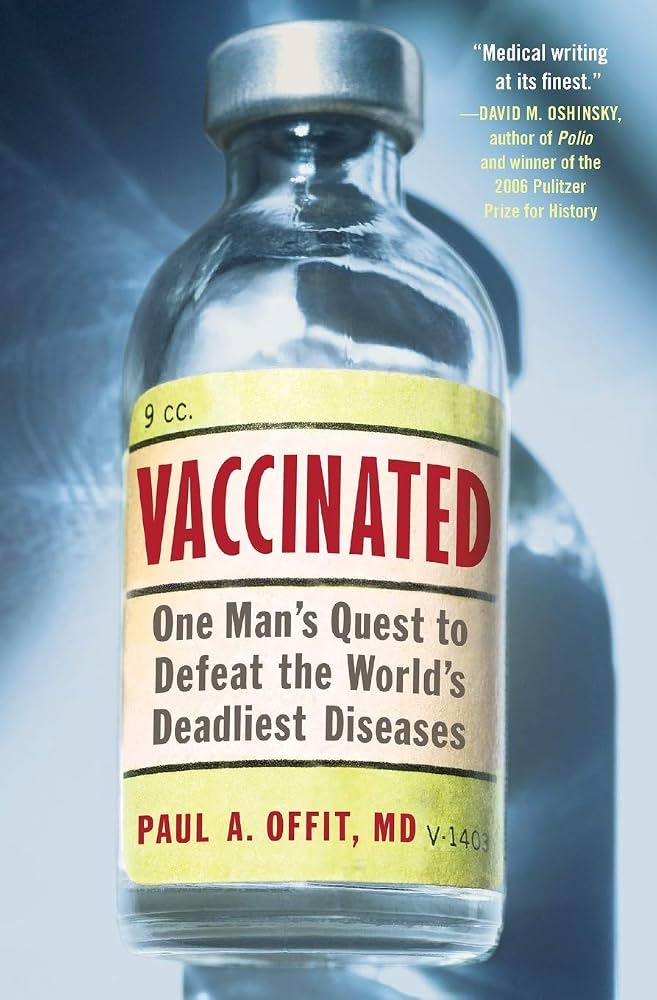
First, I carried on with last column’s Paul Offit (“You Bet Your Life: From Blood Transfusions to Mass Vaccination, the Long and Risky History of Medical Innovation”). This time I read his 2007 work “Vaccinated: One Man’s Quest to Defeat the World’s Deadliest Diseases” on Maurice Hilleman (1919-2005). Hilleman, a prolific vaccinologist, “cheated death” early: his mother died of eclampsia after his delivery and his twin, Maureen, was stillborn. His consuming career would be trying to outrun death in the lab. He is largely responsible for the variety of vaccines we now have.
Oh, vaccines. You don’t have kids in this era and escape thinking about vaccines. I have mom friends who want all of them and mom friends who want none of them, and many who land in the middle. Offit with this book was clearly trying to counterbalance the MMR panic that arose after Andrew Wakefield’s later-rescinded theoretical paper about a small patient cohort involving undisclosed conflicts of interest.
In full-tilt dramatic irony, I was reading “Between Hope and Fear: A History of Vaccines and Human Immunity” by Michael Kinch as Covid-19 landed. Like “Vaccinated,” It both celebrated the refinement of vaccines without shying away from the problems, errors, and catastrophes that have accompanied their development. Innovation is messy. Still, we labor. Still, we think. On the flip side, Forrest Maready’s “The Moth in the Iron Lung: A Biography of Polio” (2018) was a compelling juxtaposition of mass environmental poisoning events that coincided with historical polio outbreaks. As vaccine skeptics have well-articulated, the environmental context should never be ignored in treatment solution calculations.
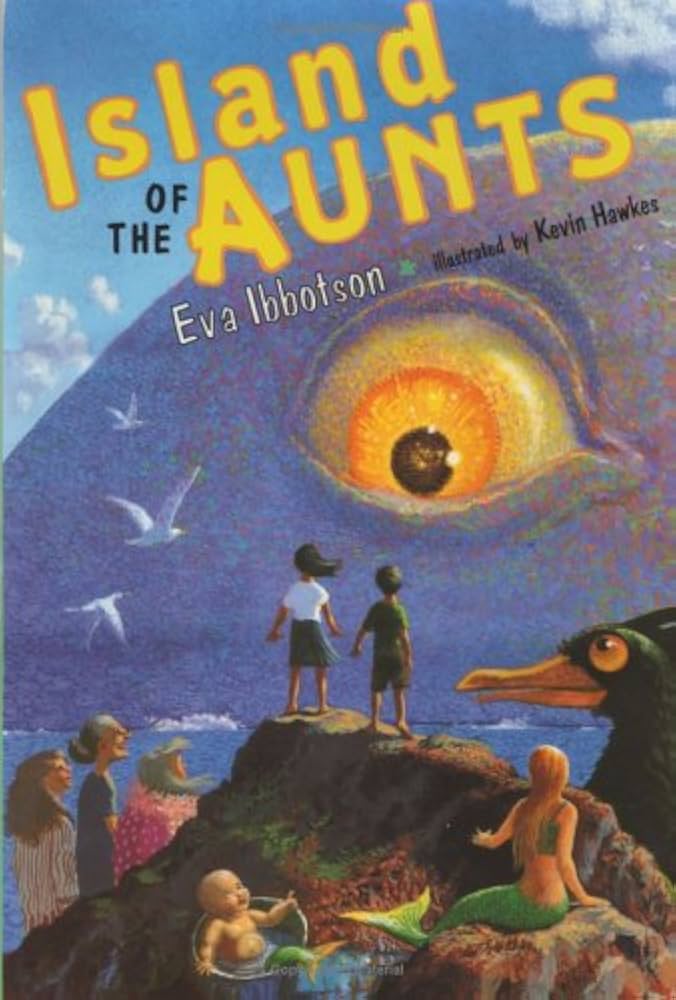
But let us digress to Eva Ibbotson’s 1999 “Island of the Aunts” (AKA “Monster Mission”). One of my kids and I keep returning to Ibbotson for read-alouds because they are so darn funny. And formulaic. In an uncertain world, I can take great comfort in formula. It’s nice to know that no matter how imprudent she is, Nancy Drew will make it out alive. Or that in the schlocky crime-thrillers R and I currently imbibe on Netflix, the old love interest is always up to something. Ibbotson, in the four titles we have tried, favors a plucky 12ish year old girl protagonist. She has usually lost one or both parents or they have some fatal flaw. She—Minette, in this story—always falls in with a boy of similar age who has often been transplanted out of a different culture. They are friends, and another, usually dreadful, boy serves as a foil. Like a Harry/Dudley contrast in Harry Potter. In this tale, a passel of elderly sisters decides to kidnap some promising children to serve as apprentices on their secret island where they care for exotic creatures. Hijinks follow. Other highly recommended Ibbotsons: “Journey to the river Sea” and “The Star of Kazan.”
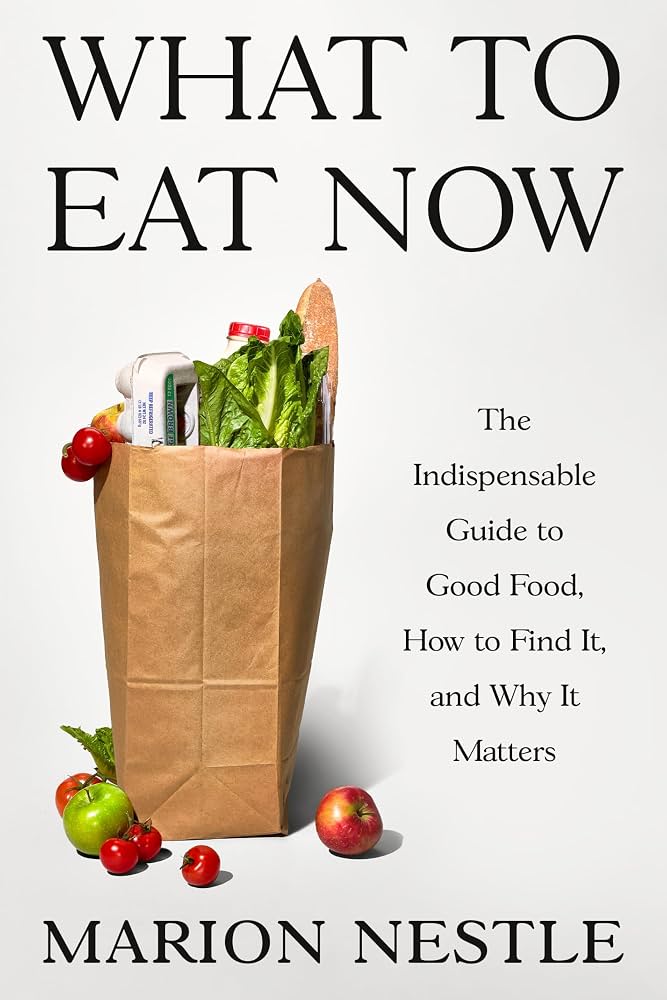
Finally, my find on the library impulse shelf. You know this shelf. It’s the library equivalent of the candy bar racks at a grocery checkout counter. Prime real estate. The books are so new and shiny, and I am much better at resisting shiny candy bars than shiny books. So Marion Nestle’s 2025 tome “What to Eat Now: The Indispensable Guide to Good Food, How to Find It, and Why It Matters” came home with me. It’s an update of her 2005 work “What to Eat.”
I met Marion Nestle years ago, in food documentaries. R’s degree work is all communication and food-based, so we have enjoyed many food documentaries (and books) of our generation like “Fed Up,” “Food, Inc,” and “Supersize Me.” Marion Nestle (PhD, MPH) and Robert Lustig (MD, MSL) were some of our favorite commentator “characters” from those films, which tend to be a blend of informative, entertaining, and propagandizing.
Marion Nestle’s tone in “What to Eat Now” is a blend of informative, sarcastic, and practical. With an advanced degree in molecular biology, she works hard to translate food jargon into everyday language, point out all the tricks and slight-of-hand in food marketing, and give ideas for how to go about your actual purchases. And being forearmed is good, because grocery stores are a psychological maze. I was mesmerized as an elementary school student by an expose I voluntarily read in “Reader’s Digest” about the layout of grocery stores, how they were engineered to get us to move through them in certain ways and colors and music were even programmatically chosen. Nestle also talks about the slotting system, how brands jockey for the best spots and market share with their dollars.
I didn’t realize it until now, but looking back at the sections and chapter headings, Nestle neatly maneuvers us section by section through the layout of a grocery store and unwraps the logistics, politics, goods and problems of such arenas as water, meat, dairy. She gets into cannabis, processed foods, takeout foods, and dietary supplements. If you have wondered it about food or the food industry, she probably tackles it. I read all of the main text, but you could also consult it about this and that and keep rolling. Definitely get “What to Eat Now” from a library. It’s huge.
Keep calm and read more books, my friends. Until next we read.