Hello, my book people. Good of you to come. I’m clearing my decks after a one-month work sabbatical (thanks, church!). Here’s what I read in July:
1. “Readicide: How Schools Are Killing Reading and What You can Do About It” by Kelly Gallagher (Stenhouse, 2009).
I bought this off a library sale cart for $1, but I’ve paid more money to try to insure those in my house read, and read well.
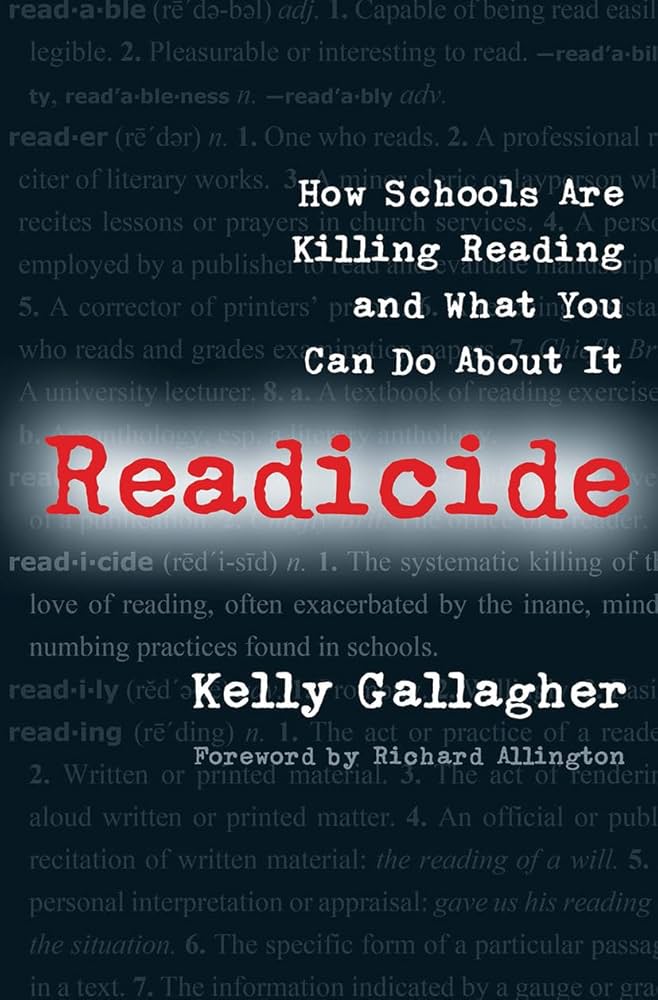
Gallagher, a veteran high school English teacher, here outs mass schooling’s late-aughts literacy problems, but any sort of reading facilitator might find practical helps. I grew up in a house with liberal access to a variety of interesting reading material: the local newspaper, Reader’s Digest (I just devoured it from about 2nd grade on) and other periodicals, and shelves of books. I don’t recall my reading ever being censored or stymied, though my parents did point me to certain books from time to time and took a “Let me know if you have questions” approach. Dad usually caught the energy of my indignation on some plot point:
“Why did she do that?” I demanded, on repeat actions by the protagonist in L’Engle’s “A Severed Wasp”.
“Do you sense the author approved?” he would probe.
He had a knack for helping me sit with human complexity, and I’m trying my darndest to sit my kids with vibrant books since we don’t have all the reading streams I had. Sometimes it’s slow to find a hit. Gallagher shares a long list of books for reluctant readers. One of the series we are reading at home is quite old and formulaic, which I find a little boring, but it’s from about a hundred years ago, so the cultural conversations we have are fun. “Why didn’t she use her phone?” “They didn’t have pocket phones back then. They had to use other resources to get out of this problem.”
Gallagher cites testing, academic interruption of the reading process, and failure to provide students with adequate book context as some factors that may harm a love of reading. Personal case in point: In 5th grade, my standardized testing rank for Reading Comprehension was that of a sophomore in college. My dutiful teacher assigned me something long and challenging: “The Grey King” by Susan Cooper. Dear reader, I could not make head nor tail of that book. As an adult, I looked it up and discovered it was part 4 of a 5-story arc. Also, it deals with Wales and Arthurian legend which my public school in the ‘90s was not in the business of instructing in, so I’m not sure why she thought this would be a meaningful read for me. Context matters, not just skill. May we supply, challenge, and support the developing readers around us.
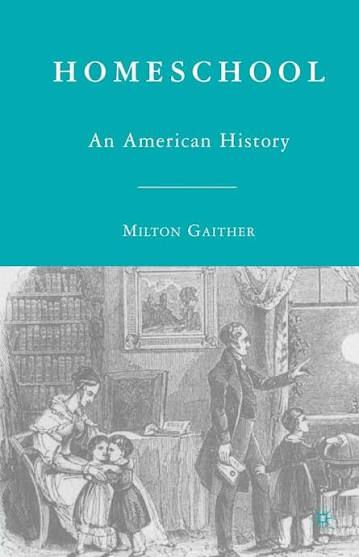
2. “Homeschool: An American History” by Milton Gaither (Palgrave Macmillan, 2008).
I had hoped to read this book alongside Stefan Merrill Block’s 2026 “Homeschooled: A Memoir,” but the memoir’s so new inter-library loan won’t release it despite there currently being about 57 available copies. (Libraries, in my experience, over-buy pop memoirs. See 2023’s “Pageboy”: 62 copies and only 1 currently checked out.)
From vibes and excerpts, it seems Block’s memoir is less about homeschooling and more about his mother’s unchecked mental illness, so the title is unfortunate for the dignity of alums and intentional practitioners, but I’ll report further if I get a hold of it.
Milton Gaither’s 2008 homeschool history (updated 2017, but I don’t have access to that edition) traces home education from the 1600s through to the modern homeschooling movement which really revved up in the mid-to-late 20th century. (I entered the scene in the late 1990s.) It was a detailed and absorbing read. The majority of the names of major players and influencers from the past 30 years were familiar to me; several have grown more ominous since Gaither’s publication. I was most unaware of the influence of Rousas J. Rushdoony on the Christian wing of the movement and of the notable court cases that cemented homeschooling across the States.
I would be curious about Gaither’s current view of homeschooling; the pandemic opened the floodgates on it. I’m glad, but weary. The early generations usually worked incredibly hard to prove themselves and stake legitimacy, and I hope we current practitioners can maintain it with thoughtful stewardship and high standards. I hope a variety of robust education options are, and stay, available in this country.
3. “The Poems of Rowan Williams” by Rowan Williams (Perpetua, 2002; this edition, Carcanet, 2014).
Two summers ago, the librarian handed me “God’s Silence,” a poetry collection by Franz Wright. Perhaps I’d ordered it in a dream because I couldn’t remember why it had come, but I loved it. I wrote at the time: “Wright is preoccupied with despair and madness. He is equally preoccupied with every image bearer looking for a hand to hold. He seems to be both a Pulitzered-author and a fumbling alcoholic (sometimes drunk on joy and hope). He occupies the thin places, always peering hither and thither about the curtain of death. The bright dazzle of human forgiveness. The discipline of failing to take ourselves too seriously.”
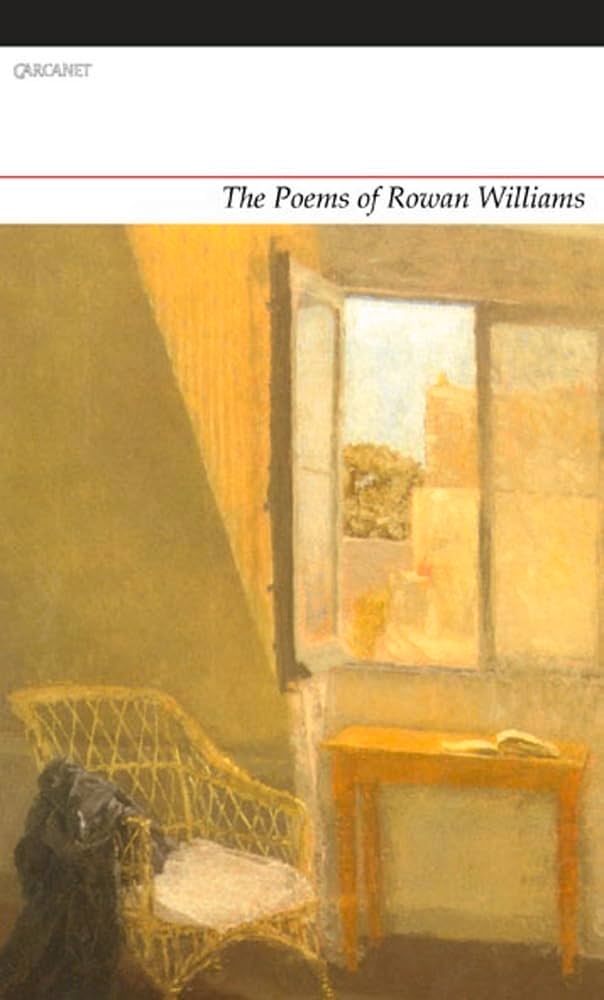
I chose former Archbishop of Canterbury Rowan Williams as my 2026 summer poet. He occurred to me when I listened to a clip of him in conversation with biologist Richard Dawkins. (Richard Dawkins is one of my favorite atheists; he is the sort of atheist only Christian England could produce. I’m pretty sure he will be a Christian again by the time he dies.) This collection amasses two prior collections of his and some later poems. A section of 12 poems is all translations, mostly from Welsh, but 3 by Rilke. Williams’ explanation in the foreword of how he translated the Welsh poems is worth reading if you grapple with those poems in the collection.
I wasn’t as thoroughly undone by Williams as I was Wright, but several poems knocked me about. First, there’s the opener, “Gwen John in Paris,” which elevates a Welsh painter lesser known than her lover, Auguste Rodin. Next, “Our Lady of Vladimir,” about a 12th century icon preserved in Russia, is somehow also about what my parenting life feels like right now. “Thomas Merton: Summer 1966” jarringly reminded me that Thomas Merton did not reside in the 16th century, where my brain so stubbornly wants to file him. A footnote remarks: “At this time, the radical monastic genius, poet, and social critic, was entangled in a tormenting and unconsummated love affair.” Wikipedia counters that the unconsummated part is not known. Living sacrifices, all the way down. Finally, I found the translations from the Welsh of Waldo Williams quite electrifying; “Song for a Bomb” and “In the Days of Caesar” were my favorite. Jeff and I got into a poem trade about the kingdom of God one day; first he sent “All the Kingdoms of the World”, which is the second part of Malcom Guite’s “Temptations” [of Christ] from the collection “Sounding the Seasons.” I sent back “In the Days of Caesar,” and he replied with C. S. Lewis.
Do you choose a summer poet? Or a winter novelist? Or a spring playwright?
4. “Homo Deus: A Brief History of Tomorrow” by Yuval Noah Harari (Harper Perennial, 2018; first published as “The History of Tomorrow” in Israel in Hebrew in 2015; the translation to English is the author’s – which is rare to see).
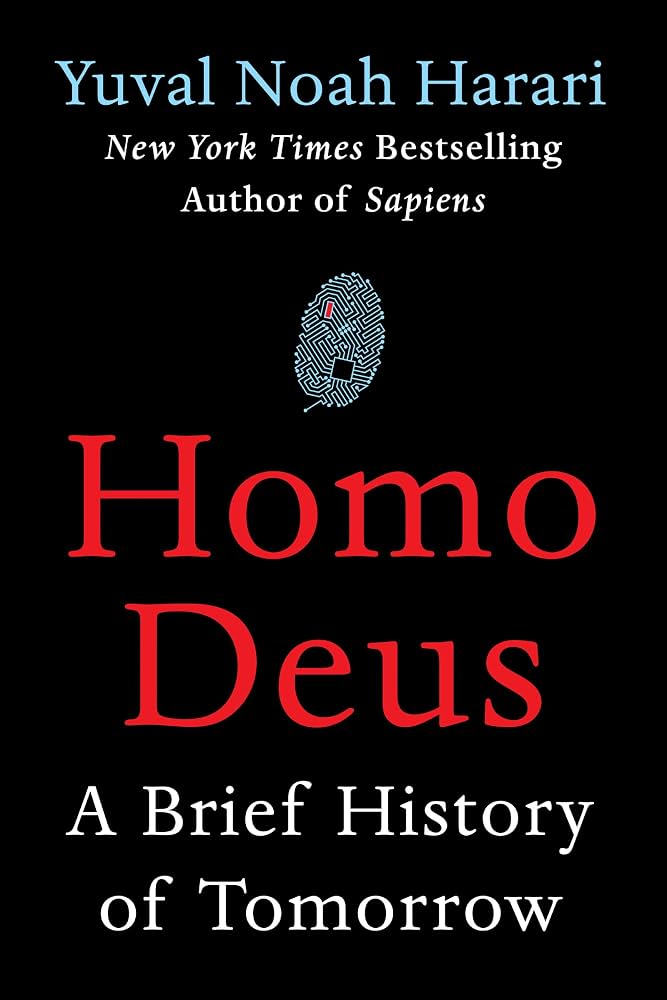
I spend a lot of time thinking about AI, and then I get mad, and sometimes when I get mad, I read. I suppose I could read something by Elon Musk or Larry Ellison or Sam Altman, but Harari came up a lot in “2084”, John Lennox’s book on AI and humanity. Therefore, I went for Harari, who is a history professor at the Hebrew University of Jerusalem. Harari boasts a number of bestselling books whose grand English titles nod at the early popular writing of Stephen Hawking (“A Brief History of Time”). Harari is not an AI developer, but he word-paints how I believe a lot of them think as they dream of new problems to solve in this age when we’ve solved much of what used to puzzle humanity (and invented a lot of new problems with our solutions, Wendell Berry might remark).
Harari notably writes, “No paradise awaits us after death – but we can create paradise here on earth and live in it for ever, if we just manage to overcome some technical difficulties” (p. 202 in the edition I had).
Oh, death. That great bug in the system. They are after it. I think this framing is key to identifying the drive of many of the tech giants. Many are atheist or agnostic; they are not looking for a heaven; they are computering their way, they hope, to the best earth possible as fast as they can. And maybe there will even be some trickle-down benefits for us normies.
I don’t want to knock innovation; we can’t. Sometimes a very important leap occurs on a very slender threshold. Read “The Lady and her Monsters” by Roseanne Montillo who catalogues the gross-out era of the grave-robbing resurrectionists. Innovators were trying to electrify several-hours-dead corpses back to life. It doesn’t work. But that type of thinking eventually got us to external defibrillation many years later. Turns out that in the correct context, at the right time, in the right way, you can electrify a body back to life.
So I suppose I’ll try to rant less and pray more for Big Tech. That their Babel Towers fall and their hubris erodes, but that their bright-eyed humanism seeds good things for all people. Many things are possible.
5. “The Mysterious Benedict Society” by Trenton Lee Stewart (Little, Brown and Co., 2007).
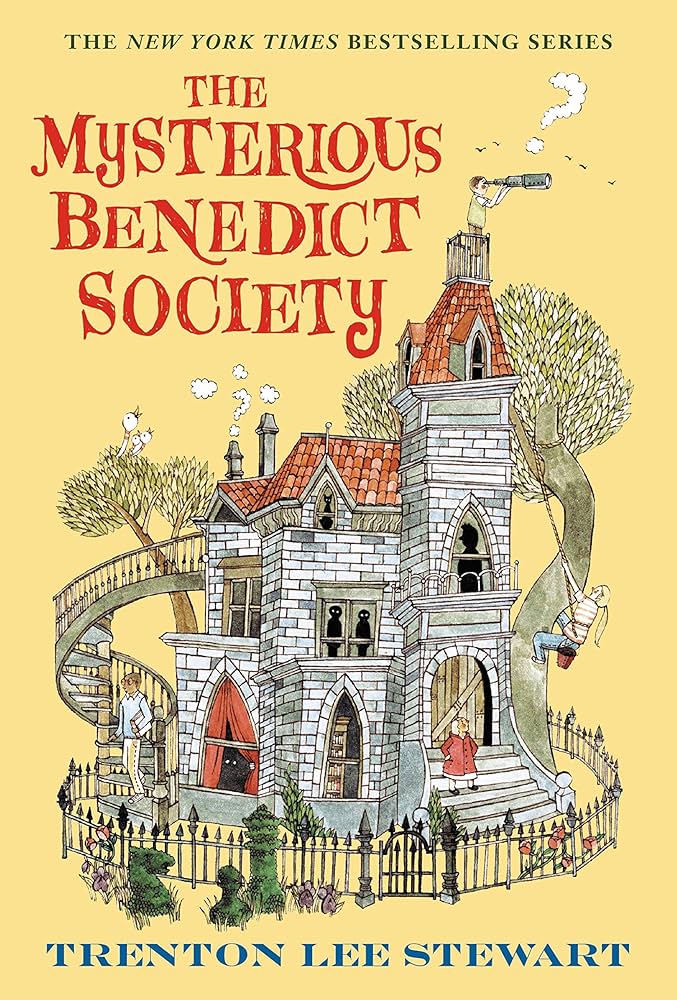
This was a first for book sourcing: a young reader in my life so doted on this book that she asked me to read it, so I did. It’s wild and long, running far over 400 pages. It would probably appeal to the sort who would enjoy the “A Series of Unfortunate Events” books (and it is a series too), being full of gifted children and long words and perils. I usually couldn’t anticipate where it was going, though it reminded me very loosely of aspects of “1984,” like an elementary school precursor. And hey, new Flock cameras have appeared in the neighborhood, so it’s never too early to start talking about how Big Brother is Watching, right?
Keep calm and read more books (dystopias and fairytales).