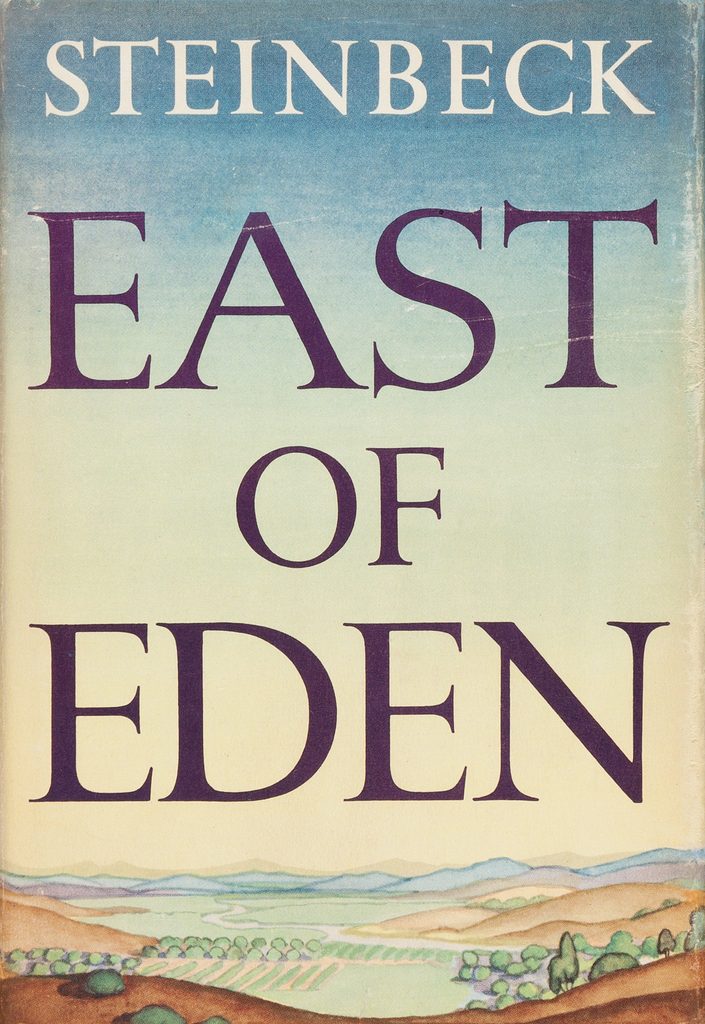
Perhaps amused by my October plan to “meander my way” through a 600-page Steinbeck in October, the inter-library loan system blocked any renewal attempts on “East of Eden” (1952).
Joke’s on you, circulation robots. I finished it in the bright morning, right before deadline. I did this with the proper ceremony, such as imbibing my spouse’s YouTube offering right before I finished the book versus right after, when it would have wrecked the afterglow. 6 AM reading is also opportune for avoiding household citizens most likely to request a snack at the climax of a book.
John Steinbeck had me rapt from a combination of the letter to his editor Pascal Covici* that precedes the text and the first page’s lengthy, intimate painting of the Salinas Valley. I can’t recall another time I felt compelled to make a diagram of the geography as described in a novel. I’ve read many works with excellent scene painting, but this was something else. I felt the land was as much seen and known for its strengths and weaknesses as the characters with which Steinbeck peopled it.
I’m reluctant to talk about “East of Eden” too much, because I relished its unfolding, and I don’t want to deprive anyone of the experience. It meditates through the Biblical lens of brothers Cain and Abel on two generations of brothers. The fixation with the Hebrew word timshel and its implications calls up for me the Solzhenitsyn quote “The line separating good and evil passes not through states, nor between classes, not between political parties either – but right through every human heart – and through all human hearts.”
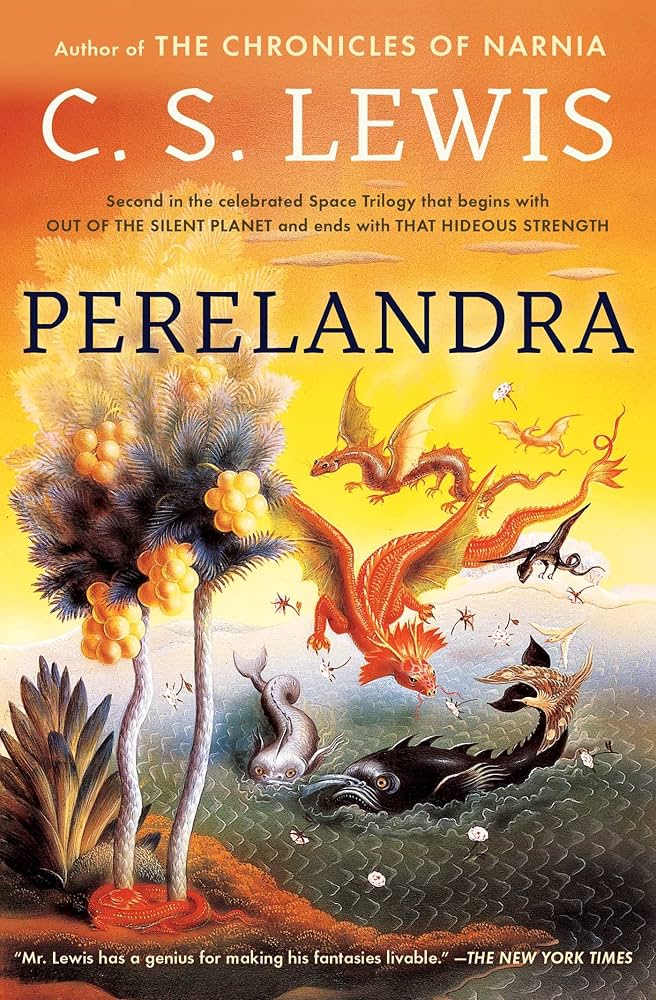
Overall, I am trying to slow down and savor one book at a time, but I had a small gap before “East of Eden” came in, and so I turned to a palate cleanser book. Do you have these? They are the books you return to when you don’t have or don’t feel up to something new. They feel worn and friendly and familiar and are perfect for a gap or holiday. For me, this niche is often filled by Dorothy Sayers’ Lord Peter Wimsey mystery series. However, I’m beginning to turn frequently to C. S. Lewis’ space trilogy now. I love them best in reverse order, so I have read “That Hideous Strength” the most. This time, I turned to 1943’s “Perelandra,” which like “East of Eden” is grounded conceptually in the Biblical book of Genesis. It imagines a freshly started planet whose first God-stamped creatures face the same choice wherein our planet broke.
The planet feels especially broken right now; I’ve never used the word “dystopian” so much as in 2026. However, it gives me courage that Lewis published “Perelandra” smack in the middle of World War II. You can feel the heaviness in the voice of his self-inserted narrator early in the text: “Then the months went past and grew to a year and a little more than a year, and we had raids and bad news and hopes deferred and all the earth became full of darkness and cruel habitations, till the night when Oyarsa came to me again.” However, Lewis still wrote novels that have inspired millions. He still dreamed.
Hold hope until you’re given something else to hold. Dream, imagine, and make art of your life especially now.
Next up: “Beren and Lúthien” (J. R. R. Tolkien; edited by Christopher Tolkien, 2017) and “The Hound of Heaven” a poem by Francis Thompson. The keynote speaker at a conference I just attended said of the poem, “Only an addict could write this.”
*In Steinbeck’s affection for “Pat,” I recalled Kurt Vonnegut’s 7th of 8 basics of creative writing from “Bagombo Snuff Box”: “Write to please just one person. If you open a window and make love to the world, so to speak, your story will get pneumonia.”