Let’s explore revolutions with children. (See my 2/13 post for works on World War 1.)
Works that expand on what my children are studying in history bear heavily on my reading choices. Recently, I was casting about for some way to push past my children’s mere polite interest in the Russian Revolution, and bejeweled eggs arose in my mind. Yes, the way to get their artistic hearts on-line was by the largest legacy of Peter Carl Gustavovich Fabergé: his imperial Fabergé eggs.
It worked like a bejeweled charm. For the eye feast, I selected the first work:
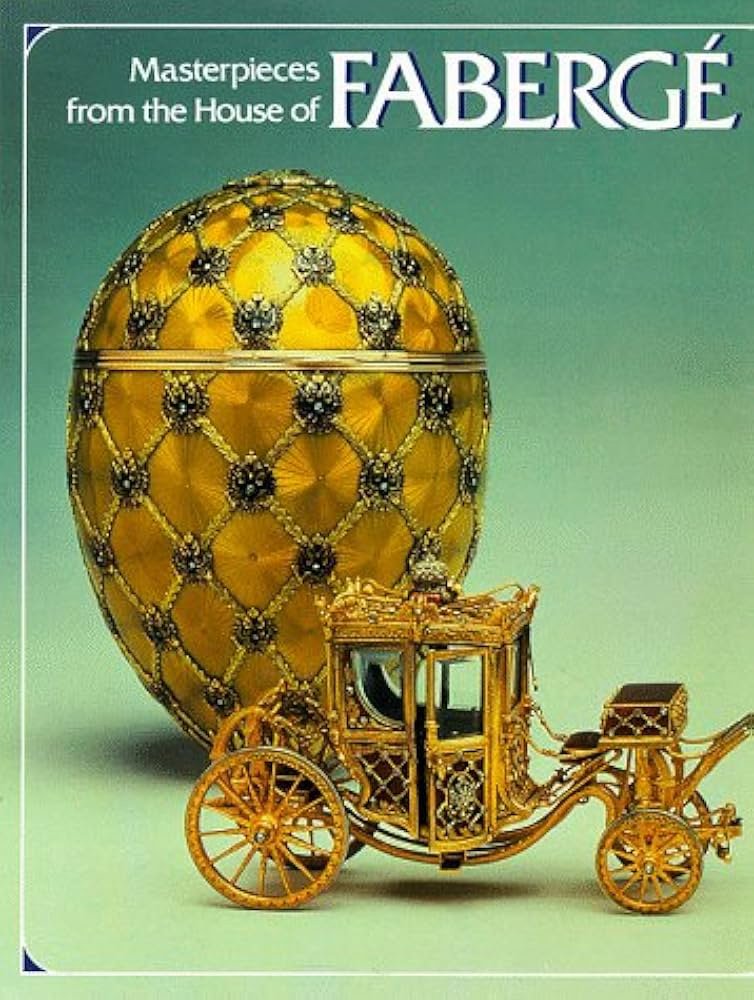
1. “Masterpieces from the House of Fabergé” (Abradale Press, 1989). The work deals prominently with the former FORBES Magazine Collection of eggs and other artifacts of pre-Revolution Russia.
I didn’t read this one (see next entry), but we paged through its glossies at length, oohing and ahhing over the delicate enamel, precious metal and gem arrangements. The czars commissioned these for the czarinas as presents during their Russian Orthodox Easter observances. With few exceptions, Fabergé presented commissioned eggs annually to the czarina (in later years the Dowager Empress got one also) from 1885 until 1916, as Russia gave was beginning to give way to revolution. The eggs most typically depicted grand moments in the lives of the Romanovs and their reign, as well as the beauty of nature. Eggs typically contained a surprise of some kind, including clever automata powered by the turn of a key. Our family took a turn at drawing Fabergé eggs and imagining what we might enclose in them (see my last post for our creations). The photo book that inspired us is available in the PINES library system.
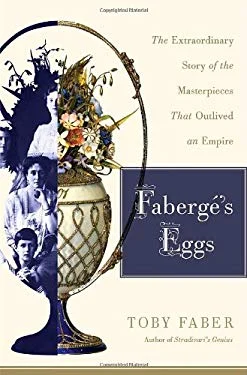
2. “Fabergé’s Eggs: The Extraordinary Story of the Masterpieces that Outlived an Empire” by Toby Faber (Random House, 2008).
This was my read proper on Fabergé eggs. The wealth and stasis of the 300-year reigning Romanovs stood in dangerous contrast to the late 19th and early 20th century state of ordinary Russians when famine often threatened and rising literacy made them chafe against frequently tabled political reforms. Faber chronicles the rise of the Fabergé firm with its rainbow of enamels and careful execution of ordinary and extraordinary objects. After the bodies of Romanovs were hidden and the country rearranged, the 50 “imperial” eggs and other treasures went all over the world (per Wikipedia, the “Winter Egg” from 1913 recently sold at auction for $30.2 million). However, in recent years, many, flown home by millions of dollars, have come back to roost in Russia at the pleasure of the rich and powerful again. This title is available in the PINES library system; it enthralled me.
3. “Animal Farm” by George Orwell (originally published in England in 1945).
Though no stranger to Orwell, I was all stranger to Animal Farm, until I binged it about a week ago. Orwell’s works are gradually creeping into public domain in some countries, and the library copy they sent me was a text-only edition published cheaply from India in 2021. I panicked; how could I read one of the most famous and challenged dystopian novellas WITHOUT critical commentary? By contrast, my recent read of “All Quiet on the Western Front” included a rich introduction and timeline of events for both the author’s life and the political/culture scene, for which I was grateful.
However, I set aside my scholar’s terror of no data scaffold. I read the story like a person, using clues and my own brain to assign identities to the various allegorical animals who turn Manor Farm into Animal Farm. “Let’s see, that is probably Karl Marx…and here’s maybe a Lenin (or Trotsky, Ron supplied)… and surely that one is Stalin…”
It’s a short read. Give it a go, if you never have. Let us have all our wits about us, as we sift and label and study the spirit of the age. This story is available in the PINES library system (with and without commentary, apparently).
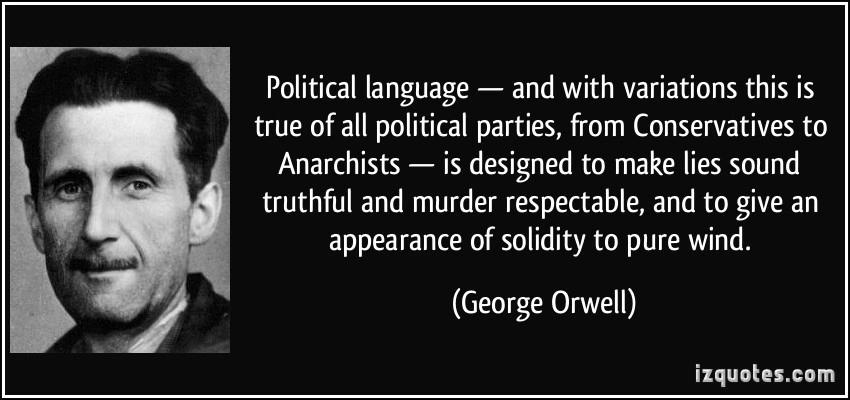
4. “Politics and the English Language” (essay by George Orwell, originally published in the British magazine “Horizon” in April 1946).
In my freshman year at A(S)U, a writing professor assigned this Orwell plea for simpler, clearer, more thoughtful political writing. In this revisit, some 20+ years later, I find that the essay marked me more than I appreciated at the time. Rereading today prods me to question more trending euphemisms.
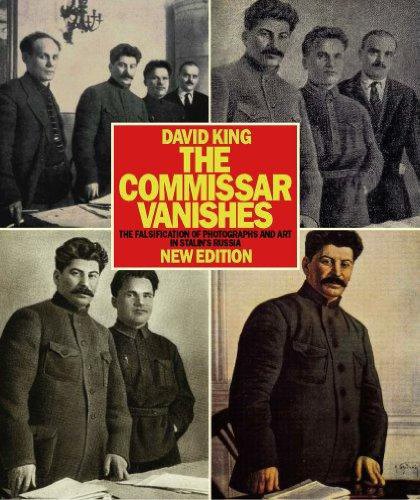
5. “The Commissar Vanishes: The Falsification of Photographs and Art in Stalin’s Russia (New Edition)” by David King (Tate, 2014).
I took an interest in “The Commissar Vanishes” about 5 years ago (thanks Anodyne for sponsoring my copy of this beast coffee table book!), and I revisited it this month on the heels of my Russian reading. It seems that not only did Stalin’s regime disappear people, it would whenever possible degrade or destroy evidences of their existence (Orwell’s “1984,” anyone?). David King’s collection contains numerous examples of books and photos where people turned persona no grata have been scratched or airbrushed from photos, or smeared hastily into opaque blobs with India ink or crayons. Sometimes the regime-offenders were simply cut out and the photos rearranged. Before our politicians could meme or AI-print their imagined universe, those of the past did it with scissors and shadow and an iron will. In a future generation they will be dissecting the distortions of now held in tweets and memes and AI slop.
A single, older edition of this work is available in the PINES library system as of this writing.
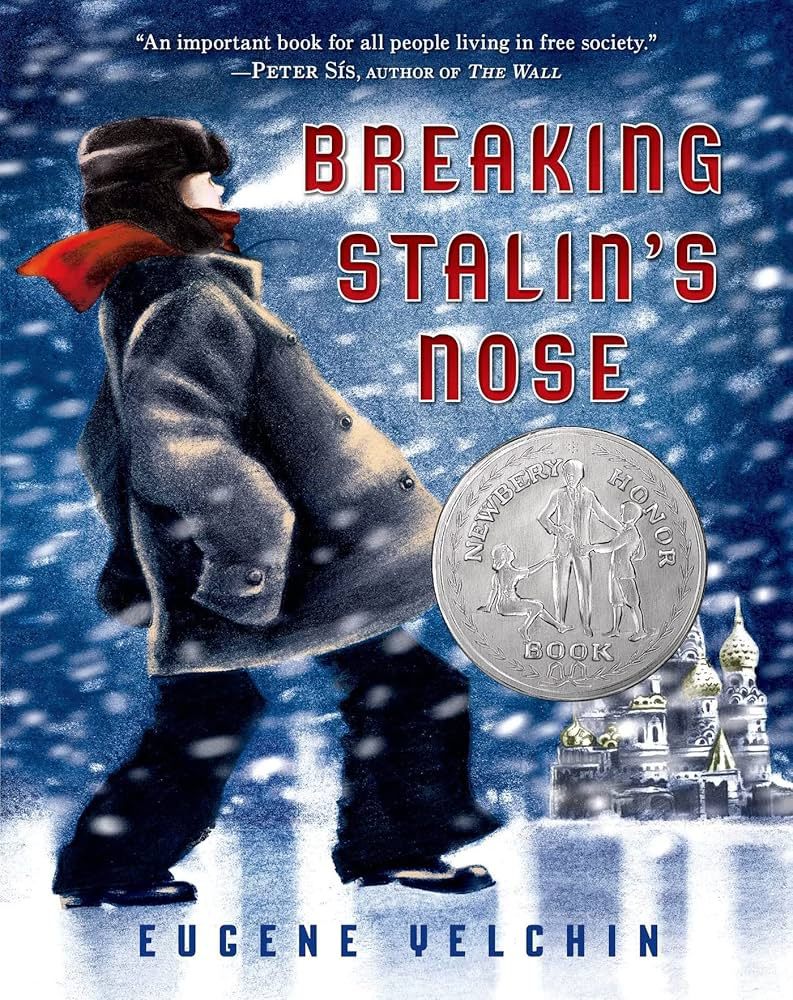
6. “Breaking Stalin’s Nose” by Eugene Yelchin (Square Fish, 2011)
Currently doing this as a read aloud with one child. It follows a schoolboy in Stalinist Russia trying to grapple with what actual reality is. Includes examples of some of the erasure techniques described in more detail in “The Commissar Vanishes.” The title is available in the PINES library system.
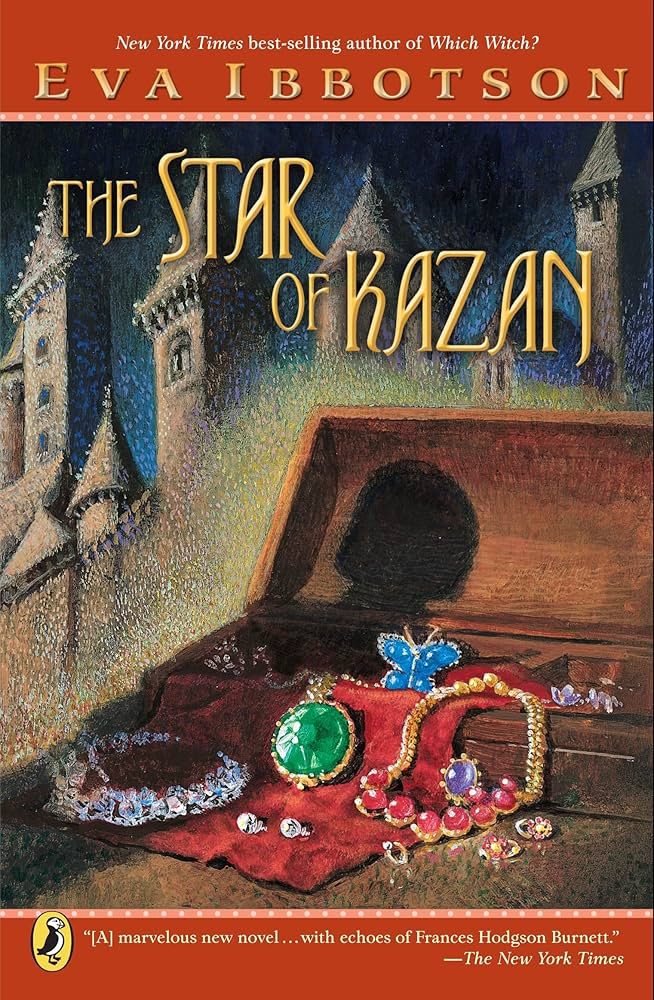
7. “The Star of Kazan” by Eva Ibbotson (Puffin, 2004).
And for a palate cleanser, this youth novel from Ibbotson. Ibbotson is for you if you like plucky female orphan protagonists who have international adventures. Ibbotson writes of Austria as she remembered and loved it, before her family had to flee because of the Nazis. Ibbotson has been likened to Frances Hodgson Burnett (“The Secret Garden,” “A Little Princess), which is apt, but she is also much funnier. Oh, how I laugh when I read these aloud. “The Star of Kazan” is available in the PINES library system.
Happy reading! One day all earthy kings will cast down their crowns…