Welcome back to my reading column! I appreciate your visit and hope you may find something here to explore if you don’t currently have a book in hand.
Today I solemnly find trench warfare mud under my fingernails after delving into regular soldiers’ accounts – one German, one Canadian – from World War I. I sat with the words of Erich Maria Remarque’s protagonist Paul Bäumer and both the words and drawings of illustrator-turned-solider Private Russell Hughes Rabjohn. For a more child-appropriate entry into the war, I’ll point you to Lindsay Mattick’s 2015 “Finding Winnie,” with Sophie Blackall’s Caldecott-winning illustrations.
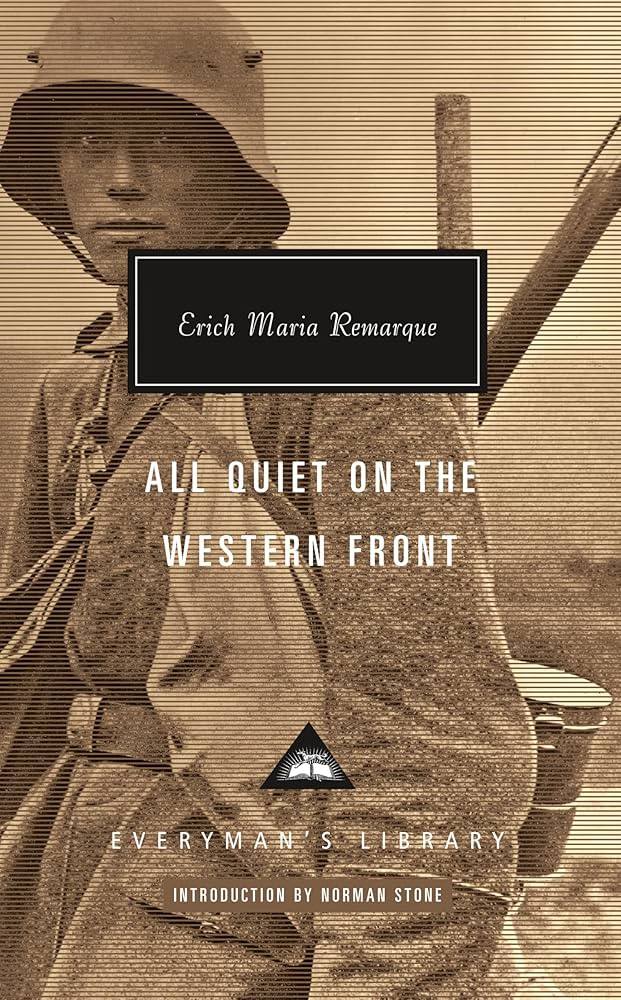
1. “All Quiet on the Western Front” by Erich Maria Remarque. The work was originally published in German in 1929 by Ullstein Verlag in Berlin as “Im Westen nichts Neues” – “Nothing New on the Western Front.” Brian Murdoch wrote the English translation I read, which is introduced by Norman Stone in this 2018 Everyman’s Library edition.
It is some kind of thrill holding a novel that has outlasted multiple governments that tried to ban and even burn it (Fascist Italy in 1929 and Nazi Germany in 1933, respectively). Additional countries suppressed it to lesser extents. And for what? For daring portray that war is not great. That war melts people down to such base states that when a bad bout of fighting cuts your company from 150 to about 80, the double rations are the focus.
“All Quiet” is a requiem for the young adult men of Germany; the narrator reckons that the ones coming behind them, too young to fight, would make their way in life all right, and those who had an established life – family, career, maybe a homestead, before the war – had something to press on for after the fighting. It was those sandwiched in the middle who came to the most ruin.
My mind wandered most when Paul was sitting with his best battle buddy, Kat, eating a stolen, roasted goose. He thinks, “We don’t talk much, but we have a greater and more gentle consideration for each other than I should think even lovers do. We are just two human beings, two tiny sparks of life; outside there is just the night, and all around us, death. We are sitting right at the edge of all that, in danger but secure, goose fat runs over our fingers, our hearts are close to one another, and time and place merge into one – the brightness and shadows of our emotions come and go in the flickering light of a gentle fire.”
I thought of two of the soldiers I know who went in young, who have seen combat or high combat loss. Their grief is carved in skin and otherwise memorialized. Both have minds like lightning, but such different politics. I could argue, and have, with either for hours. What would they talk about at the edge of battle? I wonder. Would they still choose to give their young lives to such days?
Now that I have finished the book, whose falling action punched me twice in the gut, my mind wanders to the Paris “Peace” Conference in 1919-20 that negotiated the loose ends of World War I effectually without the voice of badly battered Germany. What fresh hell followed. May we consider carefully the burdens we lay upon our “enemies.”
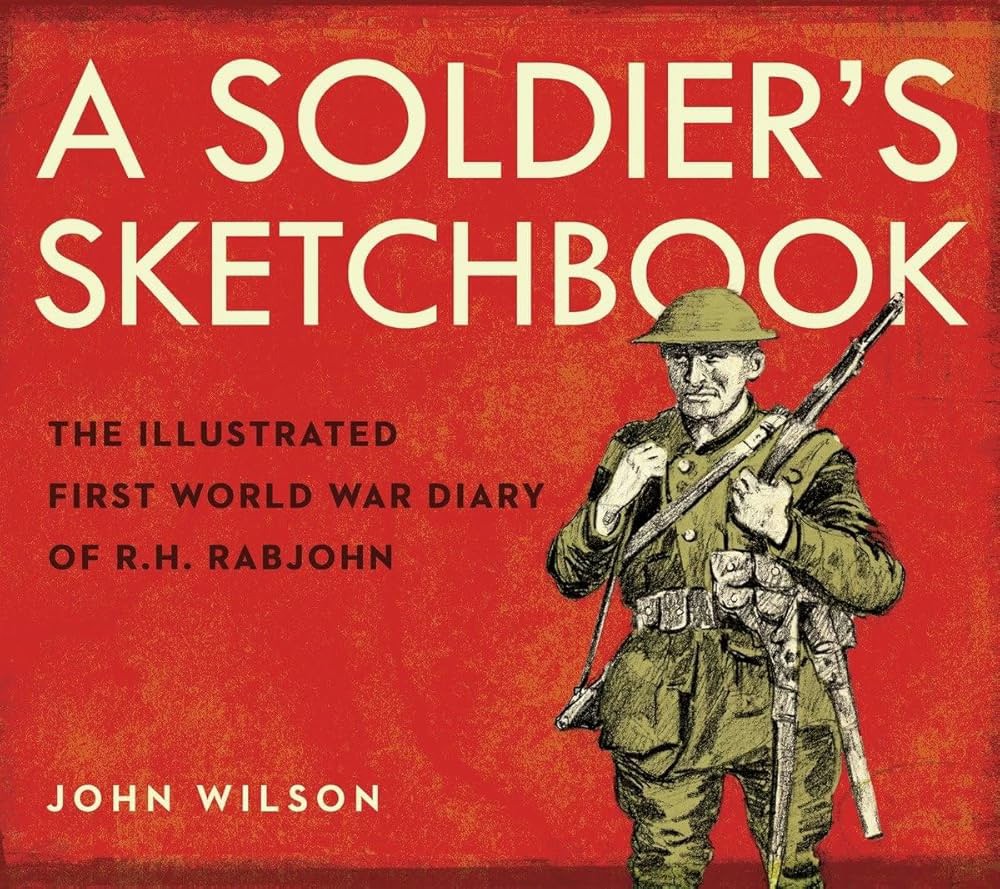
2. “A Soldier’s Sketchbook: The Illustrated First World War Diary of R. H. Rabjohn” (Tundra Books, 2017, John Wilson, editor). In a stellar find, John Wilson was given enlistee Russell Hughes Rabjohn’s privately published materials and included other material from the Canadian War Museum of Ottawa; Wilson selected portions of the writing and sketches to weave into a narrative with light commentary. Wilson notes that generally soldiers were not permitted to make any sort of rendering near the fighting, but Rabjohn’s occupation and duties gave him a rare pass to carry a notebook and sketch all sorts of scenes from the soldiers’ lives. His included sketches run the gamut from jovial bar scenes, to mid-battle to Paris while on leave to soldier and animal corpses after battles. (WWI was still an animal-heavy war; both books discuss or illustrate numerous horse/mule deaths; total animal deaths were into the millions.) The stark shifts in sketch subjects could be jarring. Rabjohn’s details are rich, and as an occasional sketch artist I stagger at the thought of him voluntarily experiencing these events in triplicate: with his vision, his mind’s eye in words, and his mind’s hand in drawings.
As a final observation on the novel and dairy, I notice in soldier memoirs that they tend to hold “enemy” soldiers of similar rank in polite esteem. In the haze of battle, Paul Bäumer accidentally stabs a French solider when startled. The wound is fatal, and the chagrined Bäumer does what he can to ease the man’s passing in the trench. Elsewhere, he tartly opines that “the wrong people are fighting each other” as he fantasizes about would-be warring country leaders fighting to the death in a bull ring and leaving the regular folks out of it. Similarly, in Canadian Rabjohn’s diary entries, he generally refers to the German soldiers by the slang of Fritz, or “Friz” in his spelling. He does this in such a calm and casual way that other than the actions he’s narrating, like “Frizs dropped bombs,” he sounds like he could be talking about a friend by nickname. May we find friends in places, and among people, that surprise us.
3. “Finding Winnie: The True Story of the World’s Most Famous Bear” by Lindsay Mattick; illustrations by Sophie Blackall.
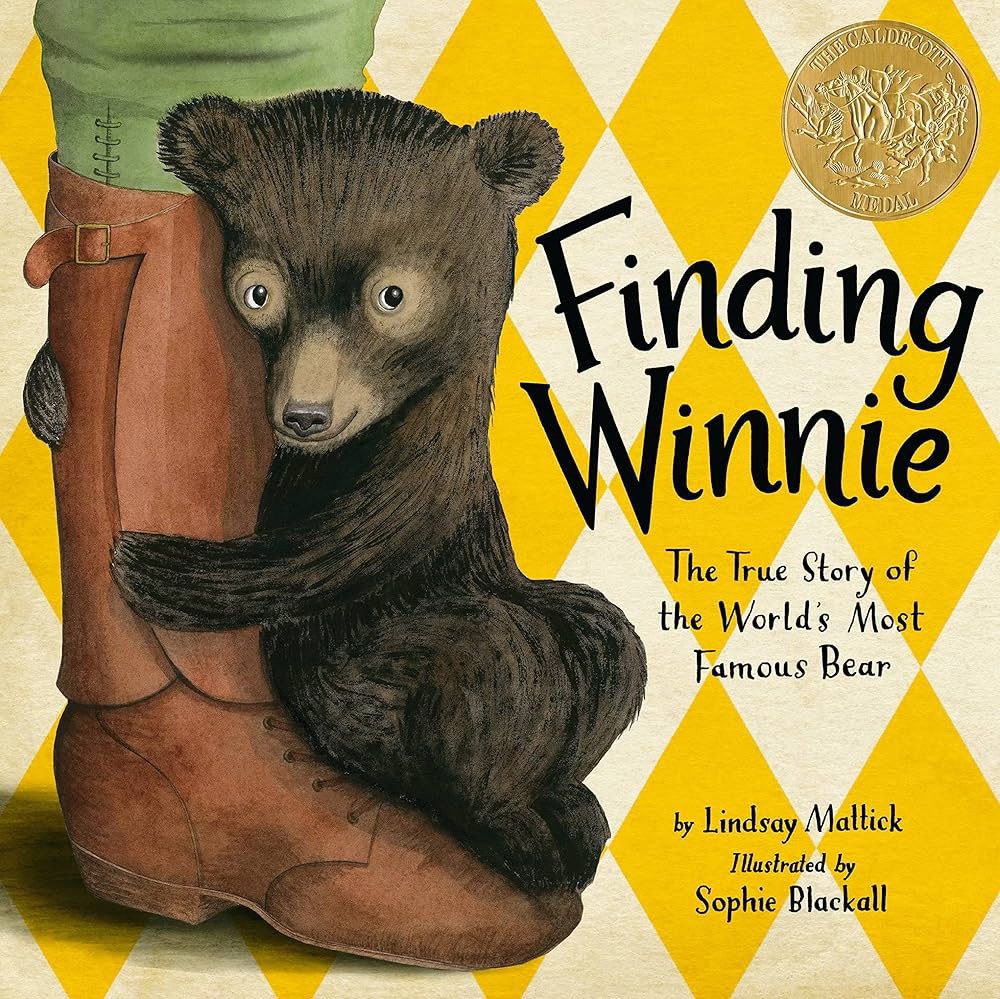
There are few characters more well-known than Winnie-the-Pooh, but I was ignorant of his WWI origins until just a few years ago. Author Mattick’s great-grandfather, Canadian veterinarian Harry Colebourn, was on his way to serve his military in WWI by caring for its horses when adventure found him. While at a train stop, he bought an orphaned bear from a random man. He named the bear “Winnie” after the Canadian city of Winnipeg. Once overseas, Harry gave the bear to the London Zoo where it became a favorite of British author A.A. Milne’s son, Christopher, thereafter spawning the beloved Pooh books.
Mattick’s tale, in addition to being sweetly illustrated, includes a number of archive photos of Harry and his bear. Our family really enjoyed the original Pooh stories, “Finding Winnie”, and the 2018 Disney film “Christopher Robin,” which imagines the titular character as a burned-out adult in need of fresh whimsy.